While fishing is slow I figured I would share some tactics I have found that catch Wrasse, Light Game style.
Now I am no seasoned light game angler and am definitely not saying "this is the only way to do it", I am merely sharing what I have found productive since springtime 2012.
That being said I find Wrasse fairly easy to catch and provide great sport on light tackle and are just so much fun.
There are five main species of Wrasse in British waters, Ballan, Cuckoo, Corkwing, Goldsinney and Rockcook Wrasse. Until now I have only caught Ballan and Corkwing on lure, though I am still hunting for the others.
Wrasse are mainly found in rocky ground, in seaweed and in both deep and shallow water. That being said you should expect to lose some end tackle when fishing for them, if you do not lose a bit, you are fishing in the wrong places!
Wrasse are daylight feeders and their strong teeth allow them to feed on a mixed diet of shelled animals such as Crabs, Limpets, Molluscs and Crustaceans.
I have used both solid and tubular tipped rods in fishing for Wrasse and though my preference is a tube tipped rod, both can be used effectively.
I honestly find rods between 7'3 and 7'6 a lot more useful than longer rods when Fishing for Wrasse, I occasionally will use my Daiwa infeet 83T, but it is seldom the first rod out the case.
Braided lines between 0.3 and 0.6 PE are just fine and I would seriously recommend using a fluorocarbon leader of around 5 or 6lb. A fluorocarbon mainline of around 3-4lb can also be useful for some techniques.
Jig head and Straight retrieve.
 |
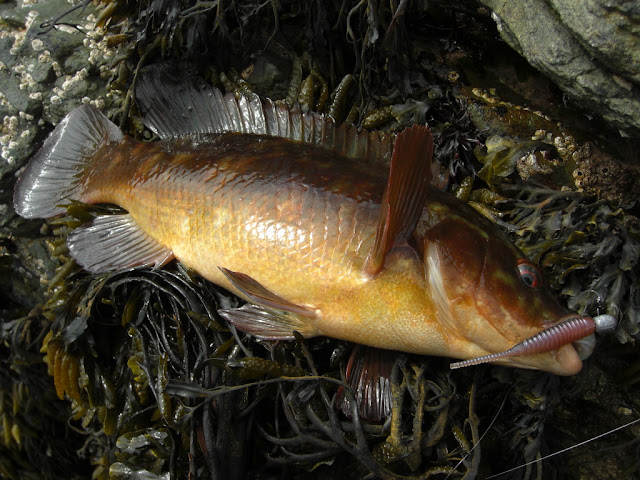
| A small Ballan caught on a decoy rocket plus head and Gulp! Alive Sandworm lure. |
Usually I tend to go for jig heads between 1g and 2.5g, but sometimes go up to 3-3.5 over high water and large tide. Hook sizes tend to be between size 8 and 4 but if the fish are really small I may go down to a size 12. You will need to choose jig heads with strong hooks and I have found ima Turtleheads, Decoy Rocket Plus heads and Muscle jig heads from AGM among the strongest out there.
The method could not be simpler, rig your chosen lure onto a jig head cast out along gulleys, structure and weed beds. Simply retrieve the lure slowly, bumping the bottom and tapping the boulders. Sometimes I will like to mix this up a bit i.e. retrieve slowly then pause, allow the lure to sit and then retrieve a little, quite often you will get a bite after the pause.
You will want to allow time for the lure to sink as Wrasse will stay quite near the bottom grazing in weed or sheltering among rocks. The closer your lure is to the bottom the more likely you are to pick up Wrasse.
Wrasse bites are fairly distinctive and give a succession of very quick taps, sometimes you will need to keep retrieving to get a hookup, other times a quick flick of the wrist and you will set the hook instantly, larger wrasse tend to nail a small lure and also hook themselves instantaneously.
Once hooked a Wrasse will tend to go for cover and it is important to be alert and take control straight away, try and steer them away from snags and boulders. Large ones you are going to have to let take line and just take it where you can. I find that once you have gotten your fish near the top of the water they tend to give up the fight and are easy enough to land.
Vertical Jigging.
 |
| Myself and Hutch fishing vertically for Wrasse. |
 |
| The Result! |
For this method I would use the same weight of jig heads as for a straight retrieve, though my lure choice might be a little more selective. I prefer to use a straw tail type lures, grubs and some needle fry type lures.
With this method, instead of casting out I would just let the lure drop vertically down the side of structure like you see above. I would also use this method for searching close to structure and searching under submerged shelves below my feet. I would tend to let the lure drop in a controlled manner, avoiding snagging the bottom, I like to stay in control and feel whats going on. Then I would simply reel in a little, so the lure is 3-6 inches off the bottom and use some short sharp jigs to entice a fish to bite. If they do not bite at the bottom I will take in a little line and repeat up the water column until I find where they are. If this still does not work I will also use long smooth lifts of the rod and allow the lure to fall back down. Often the fish will take the lure on the drop or after pausing the short jigging action.
I have taken my better fish using this method and also better numbers of fish. My favourite lure for the job is the Ima Trilobite in either Watermelon Seed or Pro Blue.
 |
| Ima Trilobites, Wrasse love them! |
Dead sticking.
Dead sticking is simply just allowing the lure, (whether casted or dropped) to just sit at a particular depth, just trusting the lure is working in the current. Some times I will allow the lure to dead stick for a minute or so and sometimes ten seconds is all that is needed. It is quite important to keep a tight line whilst dead sticking and keep an eye on your line, for if it goes slack, it may mean a fish has picked up your lure.
This method sometimes just drives fish wild and can be very productive!
 |
| Corkwing Wrasse caught while "dead sticking". |
Split shot rigs.
For hunting the mini species (Corkwing, Goldsinney and Rock Cook) I tend to use very small hooks, between size 12 and size 18. It's nigh on impossible to source jig heads with hooks so small, so one way to get around this is to use split shot weighted hooks.
I will go as light as possible using split shot and if only add more weight if needed. I do not tend to bunch the shot up above the hook, but space the shot along the leader. I may use a light shot immediately above the hook and use two heavier shot about 15cm above that. I believe this gives the lure a better hinge point and allows the lure to fall and be presented better on the drop.
It is worth looking at how coarse anglers use their split shot under floats, in order to present their baits in current and in various situations and experiment along similar lines.
I use basically the same methods as above, but it is just a way of presenting much smaller lures, on tiny hooks for smaller species, with tiny mouths. Scaling right down like this can be the difference between catching and blanking.
Unfortunately I do not have any pictures of Wrasse I have caught using split shot rigs which is unusual.
Weedless rigs.
 |
| Small Ballan caught Texas style. |
Presenting lures among weed can be a real problem when using the above rigging methods, yet sometimes it is just a necessity in order to get at the fish. When these situations arise I tend to use two main rigs; the Texas and Carolina rigs. There are other ways of doing it, for instance the Jika rig, but I have not used the other methods enough to write about them confidently.
The Texas rig however is a rig I employ a lot and is incredibly useful. I mostly use it in shallower water and really only use 2g cone weights and sizes 2, 4 or 6 hooks. Occasionally I will use 3" lures, like a Senko but I mostly use my Trilobites, Isomes and Gulp Sandworms.
Both the Texas and Carolina rig are simple enough to make and fish. More often than not a simple straight retrieve whilst bumping the bottom is all the excuse the fish need to bite, other times twitching the lure for a little then pause and repeat will induce a take.
 |
| Texas rigged ima Trilobite (M), 2g Cone and size 2 Gamakatsu G-lock hook |
The Carolina rig below has a split shot between the cone weight and the lure, really it is supposed to be done with a swivel, however doing it this way means I can adjust the length of the trace easily. The only draw back is that if I put to much oomph into the cast I can some times end up fishing Texas, the split shot will just slide down to the lure.
There are other rigs like the dropshot rig that people utilise and find very effective, but again, I have not used the rig very much and often do not see the need to.
But there is a simple summary of what I have found catches me fish, if you fancy giving the Wrasse a go on the light stuff then you may find this useful and I hope it serves you well.
For the more seasoned, you may find there is nothing new here or that I could improve on certain things, please feel free to comment and correct me if this is the case.
Many thanks for reading.
Tight lines.


